
How to Brief an Experiential Marketing Agency for Tech Events
A practical guide to briefing an experiential marketing agency for tech events: outcome, audience filter, measurement, and how to evaluate the proposals you get back.
Marketing and Talent leaders at US tech companies often face the same situation when they decide to invest in experiential marketing. They have approved a budget, they have shortlisted two or three agencies, and they need to write a brief that will get back proposals worth reading. However, most teams discover that the briefs they write produce generic proposals that look interchangeable, which makes the agency selection harder, not easier.
As someone who reviews experiential marketing briefs from US tech companies regularly, here is the honest pattern. How to brief an experiential marketing agency well is less about checklist completeness and more about clarity on three specific decisions upstream. Get those decisions right and the proposals you receive will look meaningfully different from each other. Get them wrong and you will spend six weeks comparing variations of the same booth design.
What most briefs get wrong
The most common mistake in agency briefs is mistaking specificity of execution for specificity of outcome. According to Bizzabo's 2025 State of Events report, 78% of event organizers say in-person events have unmatched impact in achieving organizational objectives. Yet few teams can tie a specific activation to a specific pipeline outcome. The gap between "impactful" and "measurable" is exactly where most agency briefs leave the work undone.
A brief that says "we want a 40-foot booth with a touchscreen demo and a coffee bar for 200 attendees" is specific about format. However, it is silent on what outcome the activation is supposed to produce, which means every agency will fill that gap with their own assumptions.
By contrast, a brief that says "we need to hire three senior platform engineers from this event within sixty days, and we want to test whether an experiential activation can produce that outcome at lower cost than agency placement" is specific about outcome. As a result, the agency has to think strategically about format, not just creatively.
Knowing how to brief an experiential marketing agency starts with understanding that format follows function, and that function has to be defined before the brief is written.
The three decisions to make before drafting
Three decisions are worth making before you write a single line of the brief.
First, define the specific business outcome the activation has to produce. This is not "brand awareness" or "engagement" or "buzz." Those are downstream metrics that are hard to attribute. Specifically, the outcome should look like "X senior hires within Y days" or "Z product trials from qualified ICPs within Q1" or "W qualified partnership conversations with decision-makers at events A, B, and C."
Second, define the audience profile the activation has to filter for. Not "developers." Senior backend developers with five plus years of distributed systems experience. Or marketing leaders at Series B SaaS companies with at least one hundred employees. The agency cannot design a filter without knowing what the filter should screen for.
Third, define the measurement system before the activation, not after. Specifically, what touchpoints will you track from booth interaction to downstream pipeline event? Without this defined upstream, the post-event report will be slides of attendee photos and you will have no real way to evaluate the agency's work.

What to include in the brief
Once those three decisions are made, the brief itself should cover six elements.
The business outcome and the metric that defines success. This goes at the top.
The audience profile and a clear description of who should not engage with the activation. Counterintuitively, defining who you do not want is more useful than defining who you do, because it forces the agency to design filters.
The constraints that matter. Budget range, timeline, geographic markets, brand guidelines that cannot be flexed, and any compliance considerations.
The measurement framework you expect. Either bring your own, or ask the agency to propose one and evaluate their proposals on this dimension specifically.
The deliverables you expect at each phase. Strategy document, creative concept, on-site operations plan, post-event report, and the timeline for each.
The decision criteria. Specifically how you will compare proposals from different agencies. This forces the agencies to address your priorities directly instead of leading with their portfolio.
What to leave out
This is where most US teams over-engineer. Specifically, leave out the creative direction. The whole point of hiring an agency is to get creative thinking you would not have produced internally. If you brief the creative direction in detail, you will receive variations of your own idea. By contrast, if you brief the outcome and constraints clearly, you will receive ideas you did not anticipate.
Also leave out the tactical execution detail. Booth size, equipment list, staffing plan. These are downstream of strategy and should be the agency's responsibility to propose. If you specify them in the brief, you are functionally hiring a production company, not an experiential marketing agency.

How to evaluate the proposals you receive back
Once proposals come in, three questions matter more than any of the others. The context is worth noting: in the first half of 2024, Bizzabo customers increased their number of events by 52% compared to the same period in 2023, with enterprise organizations hosting an average of 16 events between January and May (Bizzabo, 2024). More events means more agency proposals to evaluate, and worse signal-to-noise unless the brief is sharp.
First, does the proposal address your defined business outcome directly, or does it pivot to a different outcome that is easier to produce? Many agencies will redefine your goal because their default approach is built around brand awareness. This is a flag.
Second, does the proposal include a measurement framework that connects the activation to your defined outcome? If the measurement section is generic or vague, the agency is not equipped to deliver what you actually need.
Third, does the proposal describe a filter for your audience profile, or does it optimize for foot traffic? Foot traffic is the easiest deliverable. Filtered traffic is the harder, more valuable deliverable.
What this looks like in practice
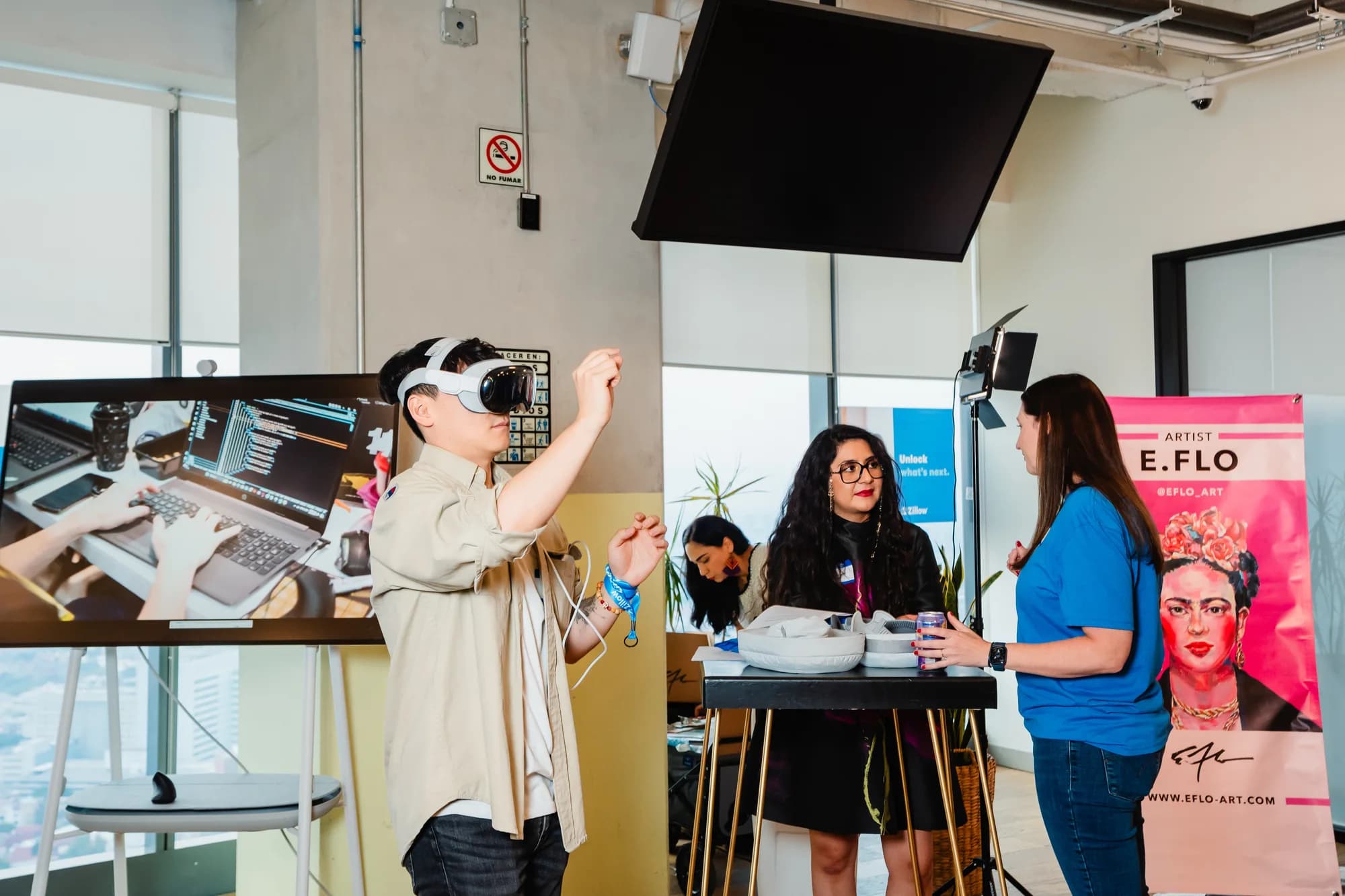
A US tech company evaluated three experiential marketing agencies for a hiring activation at JSConf México 2024. The two competing proposals were strong on creative, weak on measurement and silent on filtering. Ours was simpler on aesthetics but specific on filter design and measurement. They chose us, and the activation produced three senior hires at $8,333 each, one-third of their $25,000 agency benchmark. See the full case and cost breakdown.
The lesson was that the brief had defined outcome and measurement specifically enough that the proposals were comparable on what actually mattered.
What to do next
If you are scoping how to brief an experiential marketing agency for an upcoming technology event in México, three actions are worth taking before drafting: Define the business outcome in measurable terms. Define the audience profile and the anti-profile. Define the measurement framework you expect, or build the question into the brief itself.
That is what we build at TechBrander for tech companies running developer events in Mexico and Latin America: end-to-end strategy, design and measurement, with proposals that lead with how to deliver your outcome, not with our portfolio.
If you are briefing partners for your next activation, book a 30-minute strategy call or visit techbrander.mx. For the three-layer framework behind this guide, read Experiential Marketing for Tech Companies: How to Design It and Measure It.